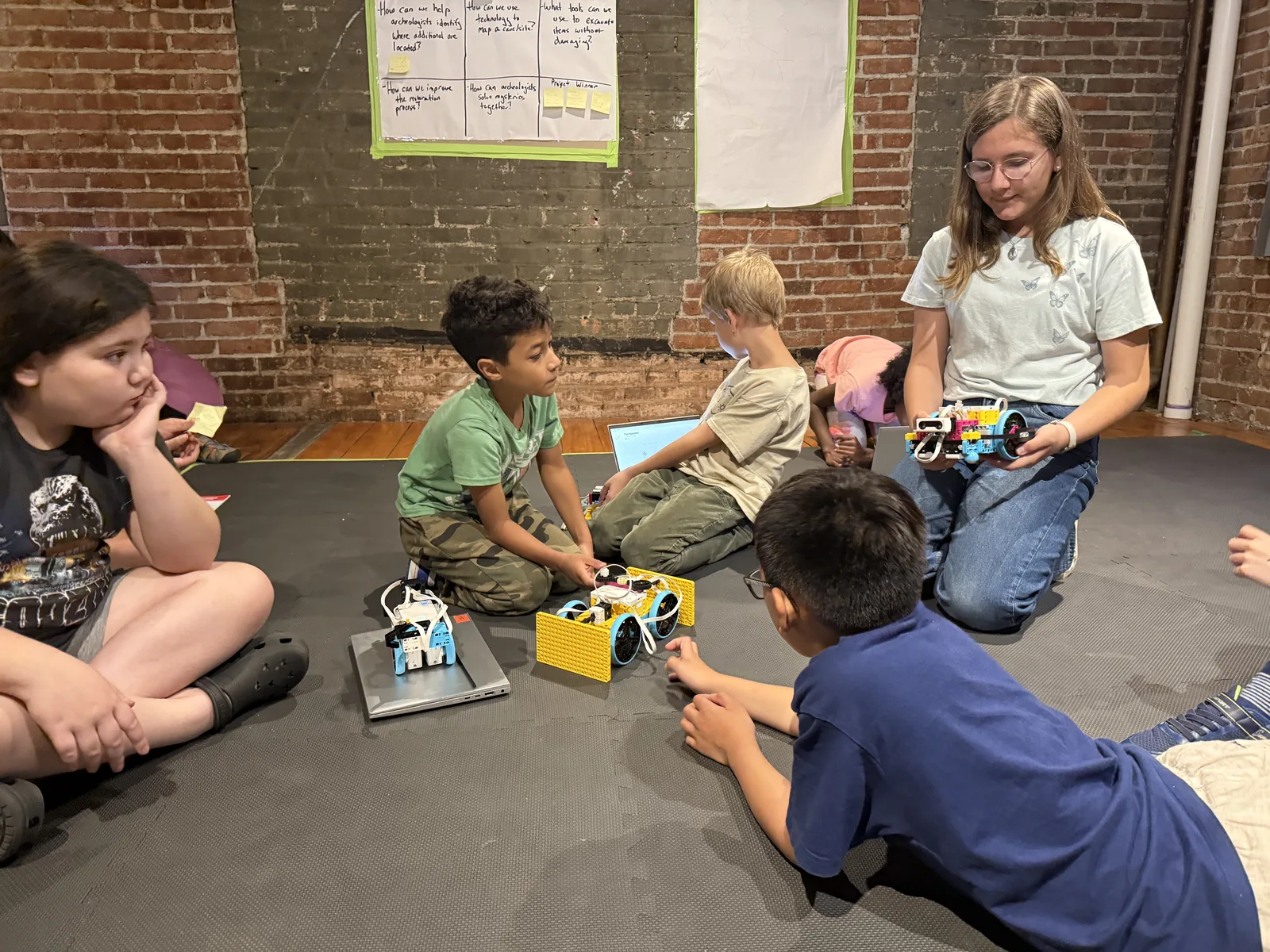
If you've come by our space on a robotics night, you've probably seen it: a cheer when a robot finally makes it across the game field, a groan when it turns two degrees too far, and then a huddle of kids talking about why. That huddle is the whole point. Robotics programs give young people a reason to think hard, work together, and keep going when the first idea fails. Here's what parents in Newburgh, Cornwall, New Windsor, and Beacon should know about the programs we run and the benefits of robotics for kids.
FIRST LEGO League and FIRST Tech Challenge, in plain terms
FIRST is a nonprofit that runs youth robotics programs used by hundreds of thousands of students every year. We run both of the FIRST programs that matter most for families:
FIRST LEGO League (FLL) for ages 9 to 14. Teams build and program LEGO robots to complete missions on a tabletop game mat. They also research a real-world problem tied to the season theme and present their own solution. This year's theme, BIOGLOW, is about biodiversity and healthy communities.
FIRST Tech Challenge (FTC) for grades 7 to 12 (ages 12 to 18). Teams design and build a larger robot from materials like metal structural components, motors, and sensors. The teams then program it and compete in matches with and against other teams. Judges also interview the team, read its engineering portfolio (the team's written record of how the robot came to be), and ask questions about how team members handled things like group organization, fundraising, and community outreach.
What kids learn in robotics programs
Engineering and design thinking. Engineers usually don't get things right with the first prototype. They build, test, measure, and improve. Both programs are built around this loop. A child whose robot keeps missing the target learns to ask why, make a change, and try again. That habit of working in small, testable steps is the same one professionals use.
Computational thinking. This means breaking a big task into small ones, spotting patterns, and writing clear instructions a machine can follow. Younger kids do it with drag-and-drop code blocks. FTC students can start with blocks too, then move on to programming languages used throughout industry like Java and Python.
Teamwork and speaking up. FLL's Core Values (discovery, innovation, impact, inclusion, teamwork, and fun) are part of what judges look at, and every team presents its research project out loud. FTC teams sit for a judging interview and must explain their design choices to adults they have never met.
Resilience. Competition days are long, and something always breaks. Learning to fix it under time pressure, or to lose a match and shake hands, is a lesson that carries far beyond robotics.
AI. Artificial intelligence is part of the world our children are growing into. We coach students to use it as a tool, not a shortcut around learning. Some of our more advanced projects may even build AI into how the robot itself works.
Robotics skills that lead to STEM careers
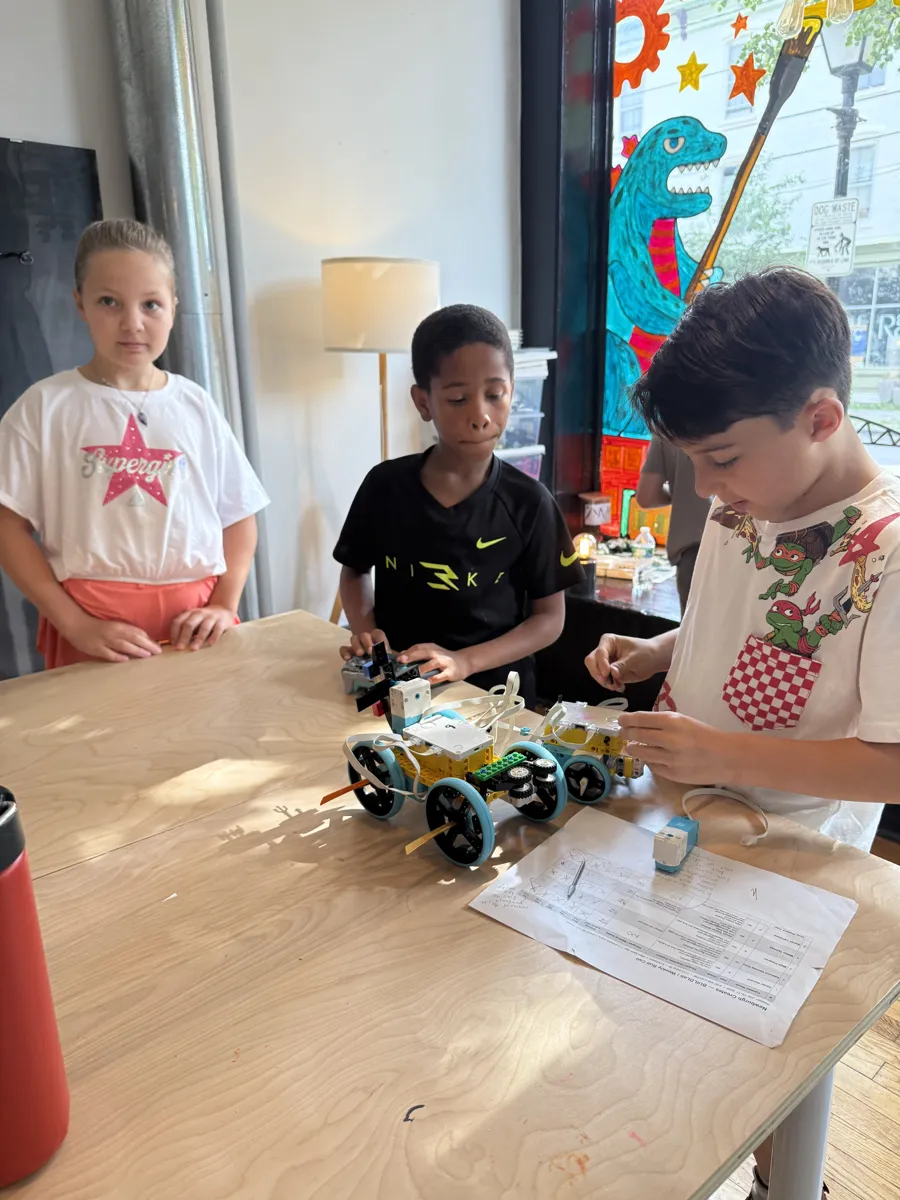
Robotics touches several in-demand fields at once:
- Software: block coding, then professional coding languages like Java, Python, C++, and Rust, along with version control like Git and GitHub on older teams. Programming concepts like debugging, troubleshooting, loops, variables, and logic are learned at all levels.
- Mechanical and electrical engineering: CAD (Computer-Aided Design, or drawing parts on a computer before cutting or 3D printing them), CAM (Computer-Aided Manufacturing, where sophisticated equipment automates the production of physical parts from digital designs), gears and linkages, and wiring motors and sensors, along with mathematical reasoning and experimental testing of prototypes.
- Manufacturing, automation, and control systems: students work with the same kinds of motors, sensors, and control logic that run everything from industrial robots, manufacturing automation, cars, and airplanes to drones, wind turbines, and even NASA spacecraft.
- Data and design: reading sensor logs, testing what works, and sketching and prototyping solutions. Students learn to merge creativity and artistic thought with hard STEM skills. They look at and analyze data to chart a path forward.
- Project management, communication, and documentation: keeping engineering and design notes, dividing work, hitting deadlines, and creating presentations. FTC and FLL judging rewards teams that show how decisions were made, tested, and refined with things like sketches, CAD models, and test results.
A child who leaves FTC or FLL has usually done a little of all of these, and has a much better sense of which ones they enjoy.
Does robotics help with college applications and scholarships?
A student who spent several seasons on a robotics team, took on a role like lead programmer or team captain, and can point to a documented portfolio has a strong, specific story that admissions officers will likely value.
There are also more direct benefits. The FIRST Scholarship Program connects participants with more than 150 colleges, universities, and businesses that offer scholarships to FIRST alumni. Each has its own amount and rules, and most applications are due in senior year. FTC teams can also nominate two 10th or 11th graders each year for the FIRST Leadership Award (formerly the Dean's List), which recognizes leadership and is a meaningful line on any application.
The research backs this up. Brandeis University's Heller School followed 1,273 students (FIRST participants and comparison students from the same schools) for ten years. Its 2024 final report found that FIRST participants were significantly more likely than their peers to take STEM courses, to major in STEM (engineering and computer science in particular), and to be employed in a STEM field early in their careers, with especially strong results for girls. FIRST's summary of the same study reports that 83% of alumni pursue STEM majors by their fourth year of college and 63% are working in STEM.
Robotics programs in Newburgh, NY: come see for yourself
No experience is needed, and kids do not have to be "the science kid" to belong here. Some of our best builders started as the ones who just wanted to play with LEGO or drive a robot around.
Our teams meet at 113 Liberty Street on a beautiful, tree-lined block in the heart of downtown Newburgh. The 2026-27 FIRST LEGO League season starts September 14, with teams meeting Monday and Wednesday or Tuesday and Thursday, 4:30 to 6:30 PM. Registration closes September 25. Program scholarships are available, with no income verification required. To join, visit our FIRST LEGO League or FIRST Tech Challenge pages, call (845) 244-6559, or email info@newburghcreates.com.
Frequently asked questions
What age can kids start robotics at Newburgh Creates?
FIRST LEGO League teams are for ages 9 to 14 and FIRST Tech Challenge is for ages 12 to 18. Younger kids (from age 7) can start with our ROBOLab and BUILDLab after-school programs and move to a team when they are ready.
What is the difference between FIRST LEGO League and FIRST Tech Challenge?
FLL uses LEGO robots on a tabletop mat and pairs the robot game with a research project. FTC is for older students, uses a larger robot built from metal parts, motors, and sensors, and is programmed in blocks or Java. Both are judged on teamwork and how the team explains its work.
Are there scholarships for robotics students?
Yes, on two levels. FIRST alumni can apply to scholarships from more than 150 colleges, universities, and businesses through the FIRST Scholarship Program, and Newburgh Creates offers program scholarships for families who need help with the cost of joining a team.
I heard FIRST LEGO League is changing. Is that true?
Yes. It appears that this year will be the final season under the FIRST name. LEGO Education has said that they plan to run a program known as "LEGO League" next season. Regardless of how these changes play out, though, we plan to keep running robotics programs well into the future. We'll share details with families as they're confirmed.
Sources
- FIRST LEGO League program page
- FIRST Tech Challenge program page
- FIRST Tech Challenge Docs: Choosing a Programming Tool
- FIRST Scholarship Program
- FIRST Leadership Award (formerly Dean's List)
- FIRST Impact page
- Brandeis University, The FIRST Longitudinal Study's 10 Years of Follow-up Data: Final Report (2024)
- LEGO Education: LEGO League launching August 2027