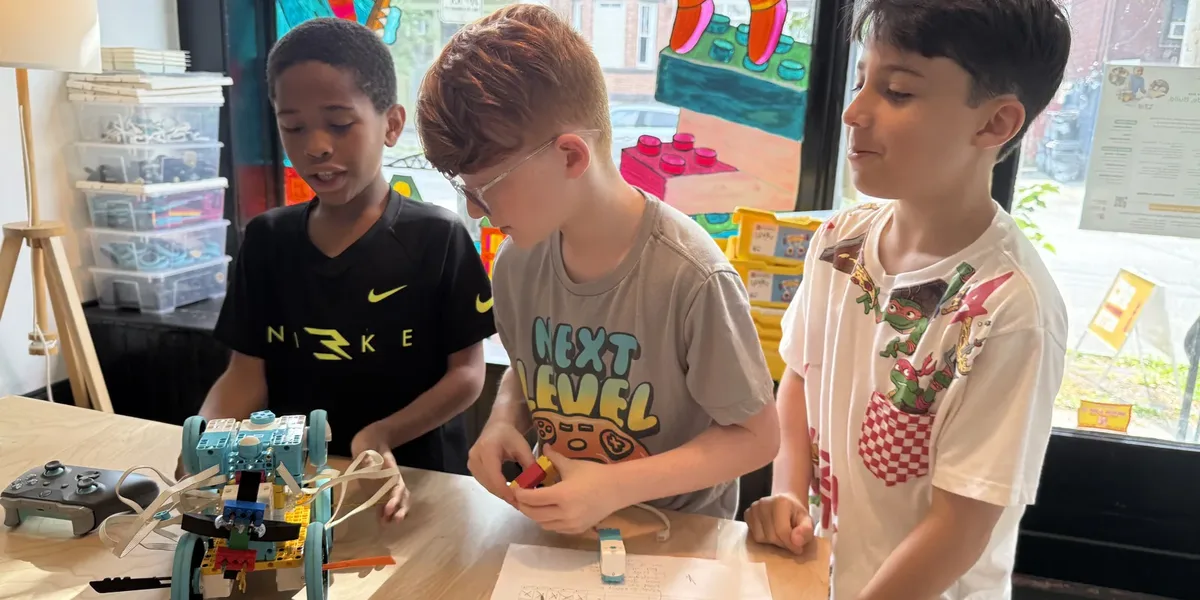
Every fall, parents ask us the same question: where can my kid compete on a robotics team? The answer is that there are a number of options available. Within a two-hour drive of our studio at 113 Liberty Street, there are robotics competitions for LEGO robots, metal robots, underwater robots, and fighting robots (battle bots), plus one you enter from a laptop. This post walks through some of the options, what they cost, and which ones our teams enter. Dates and fees are current as of early October 2026.
The FIRST Programs
FIRST is the nonprofit behind the biggest youth robotics competitions in the country. Its programs are organized by age, and each one runs on a yearly theme. This season's theme is biology, so the different competitions are called BIOGLOW, BIOBUZZ, and BIOCORE. Community teams are welcome at every level, which is how Newburgh Creates competes.
FIRST LEGO League Challenge (Grades 4 to 8)
Many families are familiar with FIRST LEGO League (FLL) Challenge. Teams of up to ten kids build and program a LEGO robot to run missions on a table-sized game mat, research a real-world problem for an innovation project, and present both to judges. Our teams build mostly with LEGO SPIKE Prime, although FLL allows any LEGO products to be used. We program our robots using Pybricks, and we've written before about what kids get out of it.
Our region is Hudson Valley FIRST LEGO League, a volunteer-run group covering Yonkers to Saratoga County. Qualifier tournaments run in January, and the champions from each qualifier advance to a regional championship in early February. Last season's championship was at Rensselaer Polytechnic Institute in Troy. Team registration is $285 for the season, and each event charges about $75. Registration for the qualifiers usually opens in mid-October and fills first come, first served.
One thing to know: this is the last season under the FIRST LEGO League name. LEGO Education and FIRST are ending a partnership that began in 1998. Both have announced successor programs for 2027-28.
FIRST LEGO League Explore (Grades 2 to 4)
Explore is the younger sibling of Challenge. Teams build a LEGO model with a motor, make a poster, and show their work at a festival rather than a scored tournament. There's no ranking, just reviewers and recognition. Registration is $150 per team and festivals charge about $35. Hudson Valley FIRST LEGO League runs Explore festivals too, though this season's dates aren't posted yet.
FIRST Tech Challenge (Grades 7 to 12)
FIRST Tech Challenge (FTC) is where robots get bigger and the engineering gets more advanced. Teams design and build a robot out of materials such as metal and plastic that fits within an 18" by 18" cube, program it in Java or with blocks, and play a game on a 12-foot field with alliance partners.
Our team competes in the New York Excelsior region, which covers all of New York State outside NYC and Long Island. The nearest qualifier is at John Jay High School in Hopewell Junction on December 5, which is about 30 minutes from Newburgh. Teams that advance go to the regional championship in Utica, which means an overnight trip. The world championship is in Houston each year.
Season registration is $350, and the robots tend to cost somewhere between $800 and $4,000 in parts and materials. Our FIRST Tech Challenge page has more on how our team works, and our community site has some additional information as well.
FIRST Robotics Competition (Grades 9 to 12)
FIRST Robotics Competition (FRC) is the top of the FIRST ladder: 120-pound robots, a six-week build season, and events in arenas. The Hudson Valley Regional runs at Rockland Community College in Suffern each March. At $6,500 to register before you buy a single part, it takes a school or a well-funded organization to run a team. We don't have an FRC team yet, but we hope to start one as soon as we can.
VEX Robotics
VEX is the other big competition system, with programs from Pre-K through college. Among other options, VEX runs the IQ competition for elementary and middle school and the V5 competition for middle and high school.
One issue with the VEX competitions is geography. As of October, the nearest VEX events posted for this season are in Westport, Connecticut, and on Long Island, and past events have clustered in Westchester and on Long Island.
VEX's official competitions are run by the Global Robotics & Science Foundation, which posts events at events.vex.com and hosts VEX Worlds in Las Vegas each spring. The REC Foundation, which ran VEX competitions until May 2026, now runs its own tournaments for the same robots under the name RECF Robotics, with events listed at recfevents.org. It also runs the Aerial Drone Competition, which we cover below under Drones.
For various reasons, we aren't running a VEX team this year. For example, there's a large FIRST community around here, and there are many local FIRST events to pick from. We do keep tabs on what VEX is doing, though, and we're open to trying it at some point. If you're interested in VEX, please reach out and let us know.
Combat Robotics
Our BattleBots kids build fighting robots every week, and it turns out there's a real competition circuit for that. This is just an early starting point, though, when it comes to combat robotics competitions.
Weight Classes
Combat robots compete in weight classes, from 150-gram fairyweights all the way up to 220-pound heavyweights, and the class sets both the challenge and the cost. These are some of the more affordable options:
- Fairyweight (150 grams): the smallest class.
- Plastic antweight (1 pound): bots built from 3D-printed plastic. Entry fees are small. Attack of the Ants in Norwalk asks a suggested $5 donation per class.
- Antweight (1 pound): the same weight, with metal parts and weapons allowed.
- Beetleweight (3 pounds): the starting class for the National Havoc Robot League (NHRL), with a separate XP tournament for newer builders.
- Hobbyweight (12 pounds) and featherweight (30 pounds): NHRL Open classes with a $75 deposit, but bigger robots and build budgets.
NHRL
The National Havoc Robot League (NHRL) runs events at its House of Havoc in Norwalk, Connecticut, about an hour and a half away. The three-pound class is open to anyone, with a $75 refundable deposit and an adult on file for builders under 18. NHRL's own starter kit, the Crash Course, costs about $500.
GSCRL
The Garden State Combat Robotics League (GSCRL) runs a full season of combat robot events across New Jersey, with fairyweight, plastic antweight, antweight, and beetleweight classes. Its 2025-26 season had eight events, at places like the Sussex County Maker Faire, the Bridgewater Mall, and the Warren County Balloon Festival, and ended with a championship at the New Jersey State Fair. The 2026-27 season opened at the Sussex County Maker Fest in Lafayette in October, and the league asks its builders to help shape the rules and schedule.
Local Antweight Events
The closest antweight events we could find are at NHRL's House of Havoc in Norwalk, Connecticut, and at GSCRL events in Lafayette, New Jersey. There's no season fee, just a small entry fee per event, which makes this one of the cheapest ways on this list to compete against other builders.
More Info
More info on local combat robot events can be found at Robot Combat Events, GSCRL, and the Connecticut Antweight Robotics League.
Reach Out
We're looking to start an NHRL or an antweight team soon, so if you're interested, please reach out.
Underwater Robots
SeaPerch is a program from RoboNation in which students build a remotely operated underwater vehicle from a PVC kit and run it through an obstacle course in a pool.
Community teams are welcome, the kit costs under $200, and the regional competition for New York and New Jersey ran in Neptune, New Jersey, in late March. It's a natural next step for kids who already know how to build and wire, and we're thinking about starting up a team soon.
Drones
The Aerial Drone Competition, run by the REC Foundation with Robolink, is a drone program built for teams like ours. Students in grades 5 to 12 fly a small classroom drone, the CoDrone EDU, through a course of piloted and programmed missions. Registration is $200 per team, community organizations can enter, and qualifiers run from October into the spring with regional championships in April and May. The program is still spreading across the country, and we haven't yet confirmed an event within driving distance, so we're watching the event list this fall.
For high schoolers, Advanced Vertical Robotics pairs a drone with a ground vehicle in an indoor arena, with teams of seven to ten.
We haven't found any local drone competitions or events, so for now, we're working on developing our own drone program in-house.
A Competition You Enter From a Laptop
Zero Robotics, run by MIT and NASA, has high school teams program a real robot aboard the International Space Station. It's free, it's all code, and the finals are broadcast from the space station in February. There's a smaller-scale summer program for middle schoolers as well.
A Few Other Options
Some programs sound promising but don't fit our current structure:
- MATE ROV, a more advanced underwater competition, has no regional event nearer than Massachusetts.
- Botball's regional is in Rahway, New Jersey, but the kit runs into the thousands. We're focusing on FTC for robotics in this price range.
- The Technology Student Association and SkillsUSA events are for school chapters only.
- World Robot Olympiad would take our LEGO robots, and community teams can enter, but WRO USA held its 2026 qualifiers in Chicago, Virginia, and California, with the international final in Puerto Rico. Nothing local, so it stays on the list for another year.
- The Wonder League is built for Dash robots. This could be another option for younger students.
- Sphero's competitions are designed around Sphero robots, which are a bit expensive.
The small robots and components we use in ROBOLab and BUILDLab, such as Edison, Arduino, and micro:bit, have no large-scale competition in the region that we know of, but they are great tools for our in-house classes and activities. It looks like FIRST may be moving toward XRP in the future, though.
What Newburgh Creates Enters This Season
Here's our plan for 2026-27.
- Two FIRST LEGO League Challenge teams, aiming for a January qualifier and the February championship.
- One FIRST Tech Challenge team, which we plan to register for the Hopewell Junction qualifier in December.
- A first competition outing for the BattleBots group.
- Possibly a SeaPerch team.
Kids who aren't on a team yet can build toward one in ROBOLab or BUILDLab, where they build the skills and knowledge they'll need. If your child is interested in competing, the best thing to do is reach out and tell us their age and what they're interested in. Partial scholarships are available for every program.
Frequently Asked Questions
What age can my child start competing in robotics?
FIRST LEGO League Explore takes grades 2 to 4 and FIRST LEGO League Challenge takes grades 4 to 8. FIRST Tech Challenge is grades 7 to 12. Our own teams cover the Challenge and Tech Challenge age ranges, and younger kids build toward them in ROBOLab.
Do we have to be part of a school to compete?
No. FIRST and VEX both welcome community teams, and Newburgh Creates competes as one. A few programs are school-only, such as the New Jersey FIRST Tech Challenge league and the SkillsUSA and TSA events.
How much does it cost to compete?
The competition organizers charge team registration fees, and most events charge a small entry fee on top. Those are the organizers' prices, not ours. Partial scholarships are available for every Newburgh Creates program.
Where are the competitions held?
The nearest events are in Dutchess and Westchester counties, about 30 to 40 minutes away. Regional championships can be farther, such as the FIRST Tech Challenge championship in Utica.
Is FIRST LEGO League really ending?
LEGO Education and FIRST are ending their partnership after this season, so BIOGLOW is the last season under the FIRST LEGO League name. Both organizations have announced successor programs for 2027-28. Our LEGO SPIKE Prime robots will stay useful well into the future. We may replace some of the LEGO hardware at some point, but we plan to use LEGO bricks and Technic pieces indefinitely.
Sources
- FIRST season pricing and registration: firstinspires.org/programs/cost-and-registration
- FIRST Tech Challenge season dates: ftc-resources.firstinspires.org
- New York Excelsior FTC events: mvcc.edu/firstrobotics/events.php
- Hudson Valley FIRST LEGO League: sites.google.com/site/hudsonvalleyfirstlegoleague
- FIRST and LEGO Education partnership update: education.lego.com
- VEX: vexrobotics.com and events.vex.com
- Global Robotics & Science Foundation: globalrobotics.org
- REC Foundation: recf.org and recfevents.org
- National Havoc Robot League: nhrl.io/events
- Garden State Combat Robotics League: gscrl.org
- Combat robot event listings: robotcombatevents.com
- SeaPerch: seaperch.org/competition and robonation.org
- Zero Robotics: zerorobotics.mit.edu
- Aerial Drone Competition: recf.org and robolink.com
- Advanced Vertical Robotics: theavr.org
- WRO USA: uselyouthrobotics.com
- Wonder League Robotics Competition: makewonder.com/robotics-competition