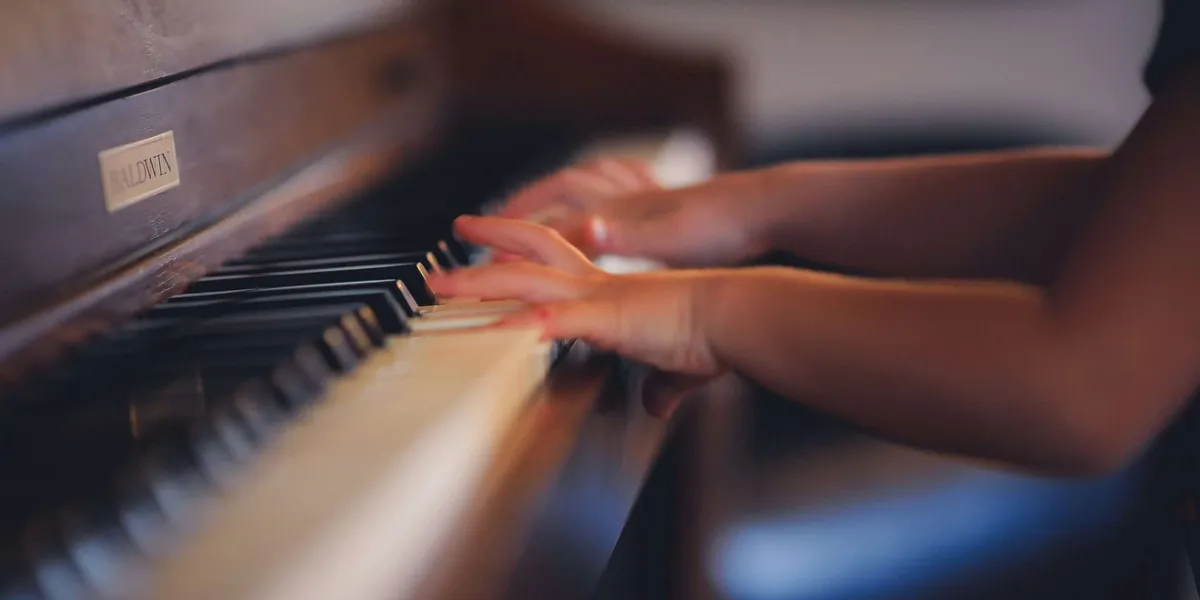
Music belongs at Newburgh Creates. Our studio is about the fusion of art and technology, hands-on and project-based learning, and building up the community here in Newburgh. We also put a priority on collaboration between students of different ages. Music can do all of this.
Piano Lessons
I'm currently offering private piano lessons here at Newburgh Creates. They're one-on-one lessons for children and adults, and they can cover classical, jazz, pop, rock, and blues. Sessions are 30, 45, 60, or 90 minutes long. You can learn more on our piano lessons page.
Music Across Our Programs
Piano lessons were an easy place for us to start. I've been teaching piano in the Hudson Valley for years, so all we needed to get going was a digital piano or two and some space.
We'd like to grow our music program well beyond private lessons, though. Music could be woven into our programs in so many ways. Here are some of the ideas we're excited about.
Music in Our Current Programs
- Homeschool: our homeschool programs would be a great place to teach music, with time during the day for classes, ensembles, and projects.
- Game development: music is a key part of video games, from custom sound effects to background music. It can even help build characters, with a theme for each hero or villain.
- Robotics: each robot could have its own character and personality: the sound of its voice, sound effects for when it's happy, sad, or frustrated, and background music while it works.
Classes
- Music theory: it's never too early to start teaching kids the basic elements of music: rhythm, melody, harmony, scales, intervals, chords, and notation.
- Music Mind Games: a games-based way to learn music reading, theory, musicianship, and more, with colorful cards and more than 200 games. More on this below.
- Kindermusik: a popular program of music and movement classes for young children, from babies to about age seven.
- Dalcroze: a sophisticated way of learning music through movement, listening, and improvisation. More on this below.
- Drumming: drumming is a really fun way to learn about rhythm and musical structure, with everything from hand drums like bongos and congas to drums you play with sticks or mallets.
- Music games: there are lots of games you can play with music, from improvisation to imitation and memory games. There's even Musopoly, a Monopoly-style board game from Music Mind Games that mixes music theory and reading.
Music and Technology
- Floor piano mats: these use electronics to make a big piano on the floor that you play with your feet.
- Instrument design: floor pianos are a good example of how electronics can make music interactive and fun. We could expand the idea into tiles that make different sounds when you jump on them, and then invent games with them, like hopscotch or four square.
- Sound design: a great way for kids to be creative and learn about technology. We could record sounds from real life, like industrial sounds, nature sounds, and city sounds, or design abstract sounds with computer programs and analog synthesizers.
- Live coding: students can learn to make music with code! Sonic Pi is a great program for this.
Partnerships
- El Sistema: a partnership with an El Sistema-inspired program could bring free, ensemble-based music to more kids in Newburgh. More on this below.
A Closer Look at Three Ideas
Music Mind Games
Music Mind Games is a method for teaching music reading and music theory through games. It uses colorful cards and other materials, and it has more than 200 original games that cover notation, rhythm, intervals, scales, key signatures, chords, and more. Teachers use it in private lessons, group classes, classrooms, choirs, and at home.
What I love about it is the philosophy behind it. Students learn in many small steps, they discover things for themselves, and mistakes are a normal part of learning. Kids are having so much fun that they hardly notice they're learning music theory.
Music Mind Games would fit right into our piano lessons, and it could be the heart of a group music class, too.
Dalcroze
Dalcroze Eurhythmics was developed by the Swiss musician and teacher Émile Jaques-Dalcroze in the early 1900s. It teaches music through three things: movement, ear training (solfège), and improvisation. Children feel rhythm, phrasing, and dynamics in their bodies before they ever see them written down.
In a Dalcroze class, the teacher often improvises at the piano while the children walk, clap, skip, and freeze with the music, sometimes with balls, scarves, or hoops. As a pianist, I find that especially exciting, because the piano becomes a way to lead a whole room of kids through the music.
El Sistema
El Sistema started in Venezuela in 1975, founded by José Antonio Abreu. The idea is simple and powerful: free, intensive music education built around playing together in ensembles. It has since spread around the world, and El Sistema USA now counts about 150 member programs in this country.
From the start, El Sistema set out to be more than a music school. Its stated goal is social change. In Venezuela, children gather in neighborhood music centers, called núcleos, where they spend hours after school and on weekends playing together. For us, the heart of it is community and child development: kids, families, and neighbors coming together around music.
One program we've been learning from is El Sistema Indianapolis. It started in 2018 with ukuleles for about 40 kids at one school, and it now serves more than 500 students a year for free, in schools, parks, and community groups. One thing I love about El Sistema Indianapolis is that it starts with ukulele and rhythm classes, which are very affordable and accessible ways to get going with music. We don't know of an El Sistema-inspired program in Newburgh yet, and we'd love to help start one.
Where Our Music Program Is Headed
We're starting small and growing from there. Next, we'd like to add group classes, like a music theory class built on Music Mind Games or a keyboard class for beginners, and bring more music into our homeschool, game design, and robotics programs. Down the road, we'd love to offer Dalcroze classes, early childhood music, and a free El Sistema-inspired ensemble for kids in Newburgh.
We'd love to hear from you. What would your family like to see? Tell us your children's ages, what instruments or kinds of music they're curious about, and what days work for you. Your answers will shape what we build next.
Meet Your Teacher
I'm a pianist and piano teacher, and I've taught classical and jazz piano to children and adults across the Hudson Valley since 2020. I started on drums in elementary school and played in marching, jazz, and concert bands before the piano captivated me. I studied piano, music theory, and jazz at Boston University, conducting and theory at the Aaron Copland School of Music at Queens College, and for more than ten years with pianist and teacher Seymour Bernstein. I love helping children and adults alike realize their dream of playing the piano.
Frequently Asked Questions
Who can take piano lessons at Newburgh Creates?
Children and adults. Lessons are one-on-one, so each one is built around the student's age, interests, and goals.
Do students need any experience?
No. Complete beginners are welcome, and so are students who've played for years. All levels are welcome.
What styles of music do you teach?
Classical, jazz, pop, rock, and blues. We often mix styles, since each one teaches something different.
How long are lessons?
Lessons are 30, 45, 60, or 90 minutes. The 30- and 45-minute lessons are for children, and adult lessons are at least 60 minutes, with 90 recommended. Rates are on our piano lessons page.
Get Started
Ready to start piano lessons, or have an idea for our music program? Contact us to schedule a first lesson or tell us what you'd like to see. You can also read more on our piano lessons page.